Publications

Our 5 Most Significant Contributions

Detection Defines Dephasing in Two-Dimensional Electronic Spectroscopy of Materials: Coherent Field Emission versus Incoherent Population Observables

Simón Paiva-Ortega, Hao Li, Eric R. Bittner, Carlos Silva-Acuña
arXiv

(

Vol. 1

 )

Cornell University (arXiv)

Detection Defines Dephasing in Two-Dimensional Electronic Spectroscopy of Materials: Coherent Field Emission versus Incoherent Population Observables

Simón Paiva-Ortega, Hao Li, Eric R. Bittner, Carlos Silva-Acuña
arXiv

(

Vol. 1

 )

Cornell University (arXiv)

Summary

New Perspective on Detection and Dephasing in Two-Dimensional Electronic Spectroscopy

Coherent multidimensional spectroscopy enables the identification of spectral structure and quantum dynamics with remarkable detail. Over the past two decades, the chemical physics community has leveraged these capabilities to address key problems across chemistry, materials science, and condensed matter physics. Yet, the information content encoded in these experiments is far richer than what is routinely extracted.

We are pleased to share our new Perspective, recently submitted for publication and now available on arXiv:

“Detection Defines Dephasing in Two-Dimensional Electronic Spectroscopy of Materials: Coherent Field Emission versus Incoherent Population Observables”

This work advances a central conceptual idea emerging from our recent efforts in ultrafast nonlinear spectroscopy: the measured homogeneous linewidth is not determined solely by a material’s intrinsic quantum dynamics, but also by the observable through which those dynamics are projected experimentally.

In other words, detection is not merely a means of measuring a multidimensional spectrum—it is a constitutive part of what the spectrum fundamentally represents.

Using a unified theoretical and simulation framework, we demonstrate that coherent emitted-field detection and action-detected approaches (including photoluminescence, photocurrent, and related observables) can yield distinct operational definitions of dephasing, even when probing the same underlying many-body dynamics. More broadly, these results point toward the evolution of multidimensional spectroscopy from a general probe of coherence into a platform for observable engineering in complex quantum materials.

This direction forms a central component of the scientific strategy of the CERC Interaction lumière–matière / Light–Matter Interactions and the Institut Courtois, with the goal of designing nonlinear spectroscopies that selectively access the correlations, relaxation pathways, and emergent dynamics most relevant to materials functionality and quantum condensed matter.

We are especially pleased to highlight that this is Simón Paiva’s first first-author publication of his PhD, marking an important milestone and the beginning of a promising research trajectory.

We thank Simón Paiva-Ortega, Hao Li, and Eric Bittner for their collaboration and intellectual partnership on this project.

🔗 The full article is available on arXiv

Biexcitons in Ruddlesden-Popper Metal Halides Probed by Nonlinear Coherent Spectroscopy

Katherine Koch and Ajay Ram Srimath Kandada
ArXiv

(

Vol. 1

 )

Cornell University

Biexcitons in Ruddlesden-Popper Metal Halides Probed by Nonlinear Coherent Spectroscopy

Katherine Koch and Ajay Ram Srimath Kandada
ArXiv

(

Vol. 1

 )

Cornell University

Summary

📄New preprint now on arXiv!
We are excited to share that our latest collaborative work, “Biexcitons in Ruddlesden-Popper Metal Halides Probed by Nonlinear Coherent Spectroscopy,” led by Katherine Koch and Ajay Ram Srimath Kandada, has just been uploaded to the arXiv.
🔗Link to the arXiv: https://lnkd.in/ePDkpB3T

In this mini-review, we explore how biexcitons — bound states of two electrons and two holes — can be unambiguously identified and characterized in Ruddlesden-Popper metal halide materials using advanced nonlinear coherent spectroscopies. This work highlights the power of multidimensional optical techniques to understand many-body interactions in quantum-confined semiconductors and strengthens the foundations for future quantum materials research.

Thank you to all co-authors and colleagues who contributed to all of our previous research papers that we review in this work. I look forward to feedback from the community and to the next steps in this exciting direction!

Resolving exciton and polariton multiparticle correlations in an optical microcavity in the strong-coupling regime

Victoria Quirós-Cordero and Esteban Rojas Gatjens
Physical Review B

(

Vol. 113

,

Issue 4

,

Pp. L041102

 )

American Physical Society

Resolving exciton and polariton multiparticle correlations in an optical microcavity in the strong-coupling regime

Victoria Quirós-Cordero and Esteban Rojas Gatjens
Physical Review B

(

Vol. 113

,

Issue 4

,

Pp. L041102

 )

American Physical Society

Summary

Image by Jose Alchis

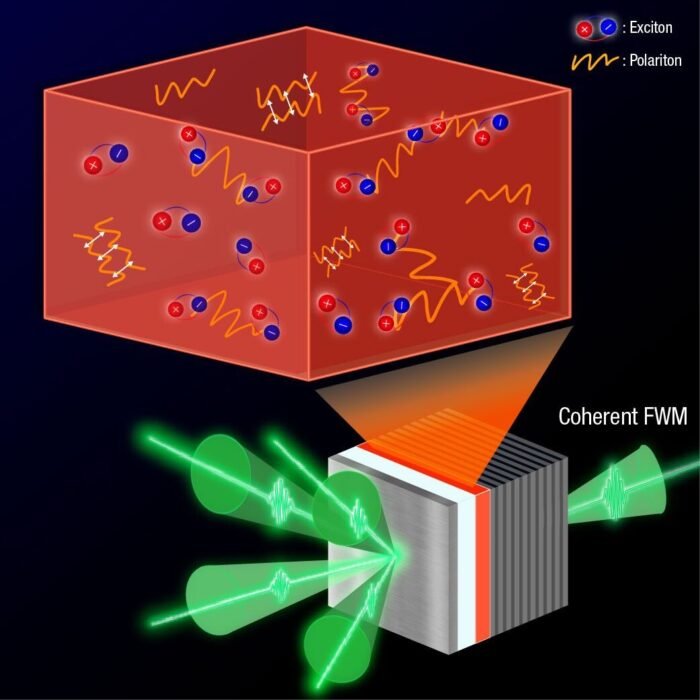
We are proud to report that our article titled “Resolving exciton and polariton multi-particle correlations in an optical microcavity in the strong coupling regime” led by Victoria Quirós-Cordero and Esteban Rojas Gatjens has been selected as an Editor’s Suggestion in Physical Review B.

Teaser text: “Here the authors use advanced nonlinear spectroscopy to directly observe how excitons and polaritons interact in a strongly coupled semiconductor microcavity. Their measurements reveal ultrafast energy flow into polariton states and uncover clear signatures of multi-particle Coulomb interactions that link reservoir and polariton modes. These previously hidden correlation pathways shape polariton behavior far beyond mean-field expectations, offering fresh insight into the fundamental processes that enable polariton condensation and other collective quantum phenomena”.

🔗Link to the journal: DOI: https://lnkd.in/gTCYM_-X

Our CERC interactions lumière-matière/light-matter interactions implements an open-science data management plan, and the links to the accepted manuscript can be found in the arXiv and all data reported in it are in the Borealis Dataverse Repository, accessed by the following links:

🔗Link to the arXiv: https://lnkd.in/gHp3ZVUb

🔗Link to Borealis: https://lnkd.in/gB3_Ey93

Strong exciton-polariton correlations shape the many-body polariton dynamics in two-dimensional metal halide semiconductor microcavities

Quirós-Cordero, V., Rojas-Gatjens, E., Gómez-Dominguez, M., Li, H., Perini, C. A. R., Stingelin, N., Bittner, E. R., Correa-Baena, J.-P., Kandada, A. R. S., & Silva-Acuña, C.
Competitive pathways for polariton condensation

(

Vol. 1

 )

arXiv

Strong exciton-polariton correlations shape the many-body polariton dynamics in two-dimensional metal halide semiconductor microcavities

Quirós-Cordero, V., Rojas-Gatjens, E., Gómez-Dominguez, M., Li, H., Perini, C. A. R., Stingelin, N., Bittner, E. R., Correa-Baena, J.-P., Kandada, A. R. S., & Silva-Acuña, C.
Competitive pathways for polariton condensation

(

Vol. 1

 )

arXiv

Summary

Polaritons are hybrid light-matter quasiparticles that condense into a quantum fluid at sufficiently high densities. Although two-dimensionnal hybrid lead-halide perovskites seem to be the ideal material platform to observe polaritons condensation, reports of quantum fluidics in these systems remain scarce. Here, using coherent non-linear spectroscopy, we provide insights into the mechanisms behind this reluctance to condensation. These insights provide guidance to the design of photonic systems to steadily achieve polariton condensation using these promising materials.

Frenkel biexcitons in hybrid HJ photophysical aggregates

Gutiérrez-Meza, E., Malatesta, R., Li, H., Bargigia, I., Srimath Kandada, A. R., Valverde-Chávez, D. A., Kim, S.-M., Li, H., Stingelin, N., Tretiak, S., Bittner, E. R., & Silva-Acuña, C.
Science Advances

(

Vol. 7

,

Issue 50

 )

American Association for the Advancement of Science (AAAS)

Frenkel biexcitons in hybrid HJ photophysical aggregates

Gutiérrez-Meza, E., Malatesta, R., Li, H., Bargigia, I., Srimath Kandada, A. R., Valverde-Chávez, D. A., Kim, S.-M., Li, H., Stingelin, N., Tretiak, S., Bittner, E. R., & Silva-Acuña, C.
Science Advances

(

Vol. 7

,

Issue 50

 )

American Association for the Advancement of Science (AAAS)

Summary

By using nonlinear coherent spectroscopy, we identify bound Frenkel biexcitons in a model polymeric semiconductor and find, unexpectedly, that excitons with interchain vibronic dispersion reveal intrachain biexciton correlations and vice versa. Moreover, we relate the biexciton binding energy to molecular parameters quantified by quantum chemistry, including the magnitude and sign of the exciton-exciton interaction the intersite hopping energies. This work shows how multidimensionnal spectroscopy can be used to gain insights into many-body physics despite the complexity of the material hosting them. This required a careful theoretical treatment of coherent dynamics to distinguish them from incoherent artefacts, which we provide in supplementary information.

Stochastic scattering theory for excitation-induced dephasing: Comparison to the Anderson–Kubo lineshape

Li, H., Srimath Kandada, A. R., Silva, C., & Bittner, E. R.
The Journal of Chemical Physics

(

Vol. 153

,

Issue 15

 )

AIP Publishing

Stochastic scattering theory for excitation-induced dephasing: Comparison to the Anderson–Kubo lineshape

Li, H., Srimath Kandada, A. R., Silva, C., & Bittner, E. R.
The Journal of Chemical Physics

(

Vol. 153

,

Issue 15

 )

AIP Publishing

Summary

Quantum dephasing is a universal phenomenon in which the quantum system loses coherence over time due to interactions with the surrounding environment. In this article, we introduced a stochastic scattering model to account for the dephasing effect on spectral line shapes through the interaction with uncorrelated excitations as a co-evolving, non-stationary environment. This non-stationary stochastic approach is generally applicable outside spectroscopy in areas like quantum technologies.

Enhanced screening and spectral diversity in many-body elastic scattering of excitons in two-dimensional hybrid metal-halide perovskites

Thouin, F., Cortecchia, D., Petrozza, A., Srimath Kandada, A. R., & Silva, C.
Physical Review Research

(

Vol. 1

,

Issue 3

 )

American Physical Society (APS)

Enhanced screening and spectral diversity in many-body elastic scattering of excitons in two-dimensional hybrid metal-halide perovskites

Thouin, F., Cortecchia, D., Petrozza, A., Srimath Kandada, A. R., & Silva, C.
Physical Review Research

(

Vol. 1

,

Issue 3

 )

American Physical Society (APS)

Summary

We dive deeper into the rich many-body physics at the heart of excitons, primary photoexcitations, in two-dimensional lead-halide perovskites. Their polaronic nature, already a product of exciton-phonon interactions, is revealed to also impact their mutual interactions. Using non-linear coherent spectroscopy, we reveal that the polaronic cloud surrounding excitons shield them from inelastic scattering, making this interaction a thousand times weaker than other non-polaronic two-dimensionnal semiconductors. This observation is a new important insight into polaron many-body physics where insights from simulations remain scarce.

Phonon coherences reveal the polaronic character of excitons in two-dimensional lead halide perovskites

Thouin, F., Valverde-Chávez, D. A., Quarti, C., Cortecchia, D., Bargigia, I., Beljonne, D., Petrozza, A., Silva, C., & Srimath Kandada, A. R.
Nature Materials

(

Vol. 18

,

Issue 4

,

Pp. 349-356

 )

Springer Science and Business Media LLC.

Phonon coherences reveal the polaronic character of excitons in two-dimensional lead halide perovskites

Thouin, F., Valverde-Chávez, D. A., Quarti, C., Cortecchia, D., Bargigia, I., Beljonne, D., Petrozza, A., Silva, C., & Srimath Kandada, A. R.
Nature Materials

(

Vol. 18

,

Issue 4

,

Pp. 349-356

 )

Springer Science and Business Media LLC.

Summary

We believe these results to be the first direct evidence of the polaronic nature of excitons in 2D-HOIPs: each line of their excitonic fine structure corresponds to a distinct exciton-polaron. This many-body paradigm is central in understanding the properties of primary photoexcitations in these materials and motivated widespread theoretical efforts in exciton-polaron physics.

Latest Publications

Overlap concentration generates optimum device performance for DPP-based conjugated polymers

Venkatesh, R., Zheng, Y., Liu, A. L., Zhao, H., Silva, C., Takacs, C. J., Grover, M. A., Meredith, J. C., & Reichmanis, E.
Organic Electronics

(

Vol. 117

,

Pp. 106779

)

Elsevier BV.
2023

Simple and Versatile Platforms for Manipulating Light with Matter: Strong Light–Matter Coupling in Fully Solution‐Processed Optical Microcavities.

Strang, A., Quirós‐Cordero, V., Grégoire, P., Pla, S., Fernández‐Lázaro, F., Sastre‐Santos, Á., Silva‐Acuña, C., Stavrinou, P. N., & Stingelin, N.
Science Publication Name

(

Vol. Advanced Materials

)

Wiley
2023

Publication Repository